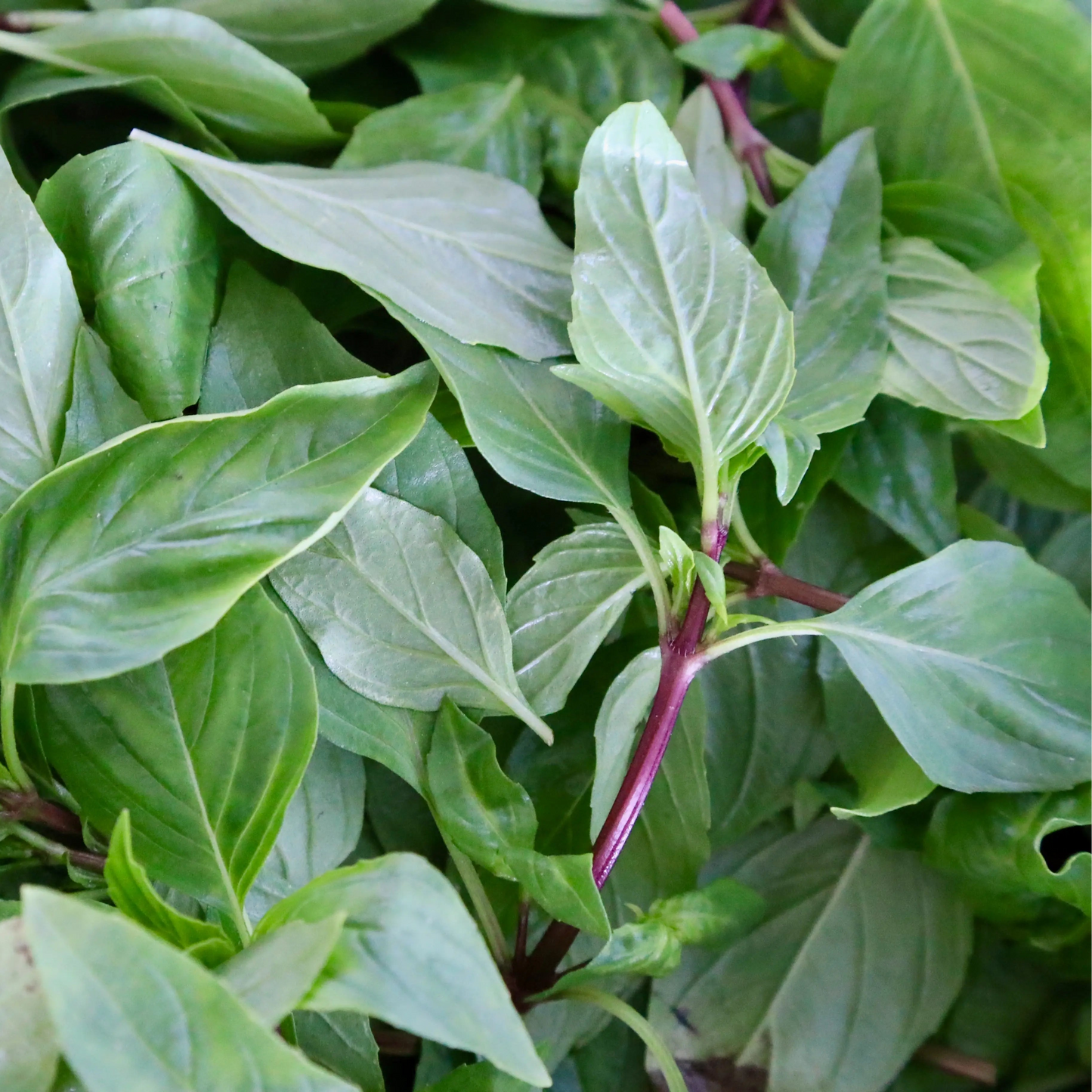
Thai Basil - Holy Basil (थाई बेसिल)
Thai Basil - Holy Basil (थाई बेसिल)
🌿 Thai Basil - Holy Basil (थाई बेसिल) — The Aromatic Soul of Asian Cuisine
Thai Basil — known in Chinese as Jiǔ Céng Tǎ (九层塔), meaning "Nine-Layer Tower" — is one of the most intensely aromatic and distinctive herbs in all of Asian cuisine. Unlike the mild, sweet Italian basil familiar to Western cooks, Thai Basil carries a bold, complex fragrance that blends anise, clove, and pepper into something uniquely its own. It is the defining herb of Thai stir-fries, Vietnamese pho, Taiwanese three-cup chicken, and Korean herb wraps — and it transforms any dish it enters with an unmistakable character. Cultivated with care at RUBY FARM, our Thai Basil is harvested at peak aroma — vibrant, fragrant, and ready to bring authentic flavor to your kitchen.
🌟 Why It's Perfect for Your Home
Intensely Aromatic & Distinctive — Bold anise and clove notes with a peppery finish — a fragrance and flavor profile unlike any other herb.
Heat-Stable Unlike Italian Basil — Holds its aroma beautifully at high heat — the ideal herb for stir-fries, curries, and hot dishes.
The Finishing Herb — Added in the last 30 seconds of cooking or scattered fresh over a finished dish for a dramatic burst of aroma and color.
Spans Seven Culinary Traditions — Indian, Chinese, Thai, Vietnamese, Japanese, Korean, and Western — one herb, endless possibilities.
🍽️ How It's Used Across Cuisines
🇮🇳 Indian Cuisine
- Tulsi chai — steep fresh leaves in hot water with ginger and honey for the classic Ayurvedic warming tea for colds and stress
- South Indian curries — added to coconut-based fish and chicken curries in Kerala and Tamil Nadu
- Northeast Indian cooking — used in Manipuri and Assamese stir-fries and chutneys
- Flavor pairing: coconut milk, curry leaves, green chili, turmeric, ginger, mustard seeds
🇨🇳 Chinese Cuisine
- Three-Cup Chicken (San Bei Ji) — the most iconic Thai Basil dish; braised chicken with soy sauce, sesame oil, and rice wine, finished with a generous handful of Thai Basil — non-negotiable
- Seafood stir-fry — pairs beautifully with clams, squid, and prawns with garlic, chili, and black bean sauce
- Taiwanese basil fried rice — torn leaves stirred into hot fried rice at the last moment
- Flavor pairing: soy sauce, sesame oil, Shaoxing rice wine, oyster sauce, garlic, chili
🇹🇭 Thai Cuisine
- Pad Krapow (Thai Basil stir-fry) — minced pork or chicken with garlic, chili, fish sauce, and oyster sauce, finished with Thai Basil — Thailand's most beloved street food
- Thai green & red curry — stir in whole leaves in the last minute of cooking for a fresh aromatic layer
- Thai basil fried egg (Kai Dao) — crispy fried egg served over rice with Thai Basil stir-fry — a classic Thai comfort meal
- Flavor pairing: fish sauce, coconut milk, lemongrass, galangal, kaffir lime, chili
🇻🇳 Vietnamese Cuisine
- Pho — served fresh on the side; tear leaves into the hot broth just before eating for a fragrant herbal lift
- Bun bo Hue — added fresh to the spicy beef noodle soup as a table herb
- Fresh spring rolls (Gỏi cuốn) — whole leaves tucked inside rice paper rolls alongside shrimp, pork, and vermicelli
- Flavor pairing: fish sauce, lime, lemongrass, chili, mint, rice noodles
🇯🇵 Japanese Cuisine
- Tempura — whole leaves coated in light tempura batter and fried until crispy — a stunning, aromatic snack or appetizer
- Ramen garnish — used as a fresh herb garnish on fusion ramen bowls for an aromatic Southeast Asian twist
- Infused sake or shochu — steep leaves in sake for a fragrant herbal cocktail base
- Flavor pairing: dashi, miso, soy sauce, mirin, sake, sesame
🇰🇷 Korean Cuisine
- Herb wraps (Ssam) — use large leaves as a wrap for grilled pork belly (samgyeopsal) or beef alongside garlic and gochujang
- Kimchi variation — occasionally used in specialty kimchi preparations for a fragrant, anise-forward flavor
- Pajeon (savory pancake) — fold into the batter for a fragrant herb pancake variation
- Flavor pairing: gochujang, doenjang, sesame oil, garlic, soy sauce, rice wine
🇪🇺 Western & Dessert Use
- Asian-fusion pizza — use as a bold substitute for Italian basil on Margherita pizza — the anise notes pair beautifully with mozzarella and tomato
- Pasta — stir torn leaves into tomato-based pasta sauces at the end of cooking for an exotic aromatic twist
- Ice cream & sorbet — infuse cream or simple syrup with Thai Basil for a sophisticated, floral-anise ice cream or sorbet — pairs exceptionally well with strawberry, mango, lemon, and coconut flavors
- Cocktails & mocktails — muddle fresh leaves with lime and simple syrup for a fragrant Southeast Asian-inspired drink base; pairs well with gin, vodka, and sparkling water
- Infused oil — blend with olive oil for a fragrant drizzle over bruschetta, grilled fish, or roasted vegetables
- Flavor pairing: strawberry, mango, lemon, coconut, tomato, mozzarella, cream, gin
🌱 Key Nutritional Notes
Thai Basil is used as a culinary herb in small quantities — its primary value is flavor and aroma. Active compounds include eugenol (anti-inflammatory, the same compound found in cloves) and rosmarinic acid (antioxidant). As a finishing herb, nutritional contribution per serving is modest — its true power is in flavor.
⚠️ Who Should Not Use or Should Take Caution
- Pregnant women — avoid large amounts: contains estragole and eugenol which in large medicinal doses may stimulate uterine contractions; normal culinary garnish amounts are generally safe, but medicinal-quantity consumption should be avoided
- Blood thinners (warfarin): contains Vitamin K and eugenol which may interact with anticoagulant medication; consult a doctor
- Pre-surgery: eugenol has mild blood-thinning properties; discontinue large amounts before surgery
- Basil / Lamiaceae family allergy: those with known allergies to mint, perilla, or other mint-family herbs may have cross-reactivity
- Infants and young children: strong volatile oils not recommended in concentrated form; use sparingly in cooked dishes only
- Normal culinary use as a garnish or cooking herb is safe for most healthy adults
🏡 Why It's Recommended For Your Home
- Freshly grown at RUBY FARM — no preservatives, no chemicals, harvested at peak aroma
- Spans seven culinary traditions — Indian, Chinese, Thai, Vietnamese, Japanese, Korean, and Western
- Heat-stable and versatile — works in stir-fries, curries, soups, teas, desserts, and cocktails
- A rare specialty herb that brings genuine restaurant-quality flavor to your home kitchen
- Once you cook with fresh Thai Basil, dried herbs will never feel like enough again
Couldn't load pickup availability
Out of stock
View full details